Forward Deployed Engineers and AI Coding Agents: Building Reliable Software in the Age of Intelligent Automation
Artificial intelligence is transforming how businesses design, develop, and maintain software. Tasks that once required extensive manual programming can now be completed by AI coding agents that generate code, analyse data, connect APIs, and automate complex workflows.
Developers can ask tools such as Claude Code, Cursor, or OpenAI Codex to create applications, troubleshoot errors, and build integrations using natural language instructions.
However, there is a significant difference between generating functional code and deploying reliable software that businesses can depend on.
An AI coding agent might develop a web scraper within minutes. The scraper may initially collect product prices, job listings, or competitor information accurately. But what happens when the target website changes its layout, introduces new security restrictions, or modifies its underlying data structure?
The automated system may stop working, produce incomplete information, or return inaccurate results without immediately alerting the business.
This is where a forward-deployed engineer becomes particularly valuable.
Rather than focusing exclusively on writing code, forward-deployed engineers combine software development, technical implementation, business communication, integration, testing, and ongoing problem-solving.
They work directly with organisations to understand operational challenges and transform AI-generated prototypes into dependable business solutions.
As companies increasingly adopt autonomous coding agents and intelligent automation, the demand for engineering professionals who understand both business requirements and technical execution becomes more important.
This article explores how AI coding agents are changing software development, why automated systems require human supervision, and how forward-deployed engineers help businesses implement reliable technology.
The New Software Development Model: From Manual Coding to AI-Assisted Engineering
Traditional software development usually involves a clearly defined sequence of activities.
Business stakeholders communicate requirements to project managers or analysts. Software engineers design the technical architecture and write application code. Quality assurance teams test the completed features, and deployment engineers prepare the application for production.
Although effective, this approach can involve several communication layers.
AI-assisted development is changing the process.
Modern coding agents can receive a written instruction, inspect an existing project, generate source code, and suggest improvements.
For example, a developer might instruct an AI agent to create a dashboard that displays daily product sales, customer activity, and inventory availability.
The agent could generate frontend components, backend endpoints, and database queries based on the provided instructions.
Instead of writing every line manually, engineers can concentrate on evaluating architecture, validating business logic, and improving system reliability.
This creates opportunities to accelerate development, particularly for repetitive or clearly specified tasks.
However, AI-generated code is not automatically secure, accurate, scalable, or maintainable.
An agent may misunderstand a business requirement, introduce unnecessary dependencies, mishandle sensitive information, or generate a solution that performs poorly under production workloads.
The challenge is no longer limited to producing code.
Businesses must ensure that AI-assisted software behaves correctly, remains secure, and continues functioning as operational requirements change.
What Is an FDE? Understanding the Forward Deployed Engineer
What is an FDE?
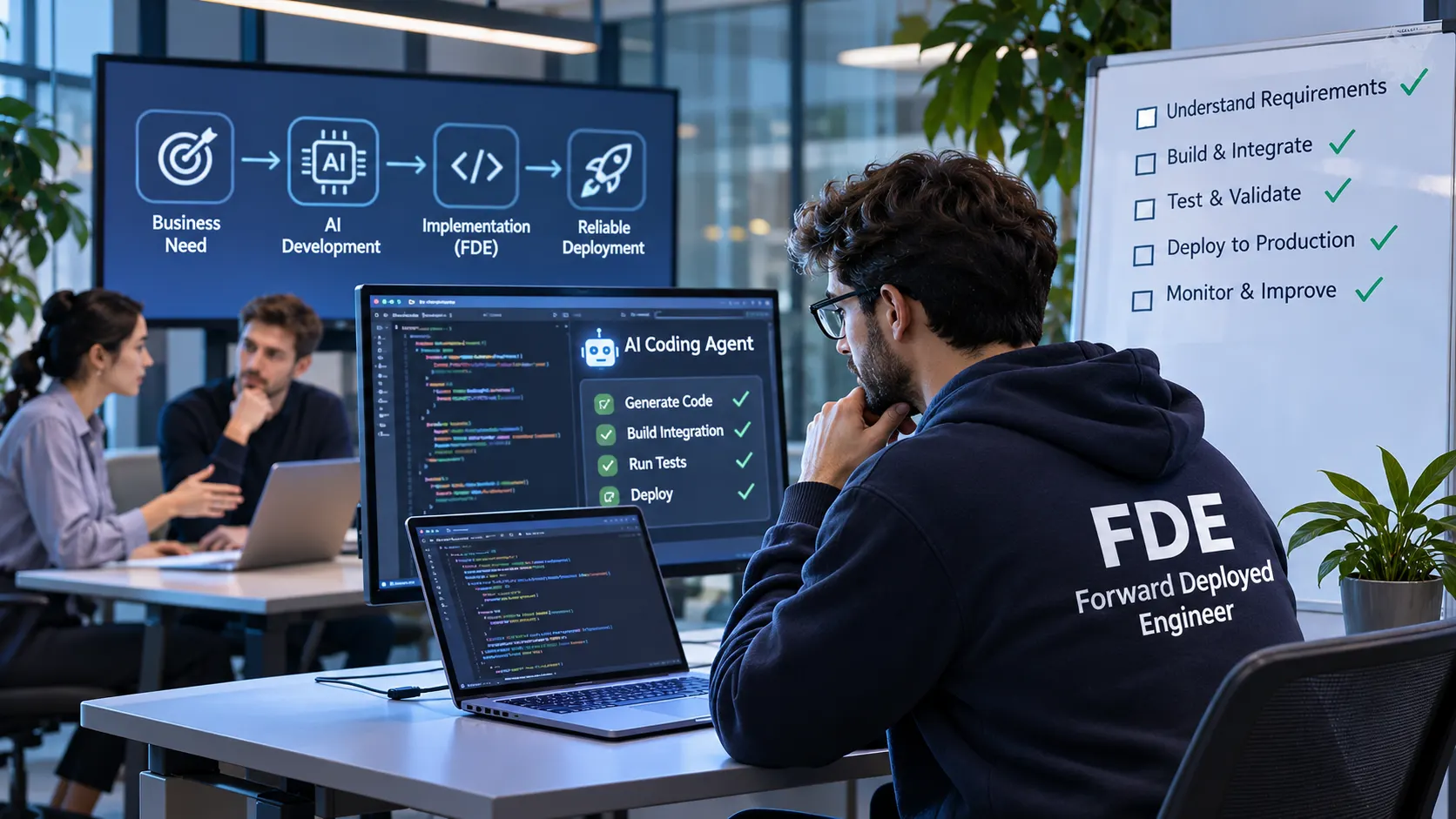
FDE stands for Forward Deployed Engineer, a technical professional who works closely with customers or business teams to understand their requirements and implement software solutions directly within their operating environment.
Unlike a conventional software engineer who may work primarily on internally assigned development tasks, a forward-deployed engineer combines hands-on technical work with direct stakeholder collaboration.
An FDE does not simply receive a list of requested features.
The engineer investigates why those features are necessary, identifies the underlying business problem, evaluates technical limitations, and develops an appropriate solution.
For example, imagine an e-commerce company struggling to synchronise product prices and inventory across multiple platforms.
A traditional development workflow might involve customer support collecting the complaint, a project manager creating tickets, and software developers implementing changes.
A forward-deployed engineer could participate in those discussions directly, inspect the integrations, identify the source of the problem, and implement a technical solution.
The same engineer may also test the integration, deploy the updated functionality, and monitor its performance.
This combination of technical expertise and customer-facing responsibility distinguishes the role from more narrowly specialized engineering positions.
However, FDE responsibilities vary between organizations. Some focus heavily on implementation and coding, while others concentrate on enterprise AI integration, data engineering, or deployment architecture.
Why Forward Deployed Engineers Are Becoming Important in AI Development
Artificial intelligence has increased the number of software capabilities businesses can experiment with.
Companies can now build chatbots, data extraction tools, recommendation systems, and workflow automation applications much faster than before.
Yet many AI projects struggle when they move beyond demonstrations.
A prototype may perform correctly using a small sample of carefully selected data but fail when connected to actual business processes.
Real environments contain inconsistent records, unusual user behaviour, incomplete information, legacy systems, and security restrictions.
AI models also produce probabilistic outputs, meaning their behaviour may vary even when given similar instructions.
A production application must account for these uncertainties.
Forward-deployed engineers help organisations address this gap between demonstration and deployment.
They investigate how a business actually operates, identify the systems that must communicate, and establish safeguards around automated decisions.
For example, an AI customer support assistant might successfully answer common questions during testing.
However, its deployment requires additional consideration:
Which customer records can the assistant access?
How should it respond when information is missing?
When must a human support agent approve a response?
How are conversations logged and monitored?
What happens when an external API becomes unavailable?
How should incorrect answers be detected and corrected?
These are engineering and operational questions that cannot be solved through prompt writing alone.
Forward deployed engineers address such issues by combining technical implementation with an understanding of the customer's environment.
What Does Forward Deployed Engineers Do in Real Business Environments?
A common search question is "what does forward deployed engineers do?"
More naturally, the question is: What do forward deployed engineers do during a software project?
Their responsibilities generally extend across the entire implementation lifecycle.
1. Understanding the Business Problem
An FDE begins by communicating with stakeholders and examining the current workflow.
The engineer identifies operational difficulties, unnecessary manual tasks, technical limitations, and opportunities for automation.
Instead of immediately proposing a new application, the engineer determines whether the problem can be solved through improvements to an existing system.
2. Translating Requirements Into Technical Solutions
Business requirements are often expressed in nontechnical language.
A company might request a system that automatically updates product availability across multiple sales channels.
The FDE converts that requirement into a technical plan involving APIs, database synchronization, scheduled tasks, error handling, and appropriate monitoring.
3. Writing and Integrating Software
Forward deployed engineers are expected to possess practical development capabilities.
They may build backend APIs, develop frontend interfaces, create data pipelines, integrate cloud services, or customize existing software.
The specific work depends on the project and organization.
4. Testing and Quality Assurance
An FDE may also perform technical testing and coordinate formal QA.
This involves evaluating whether the system produces correct results under normal and unusual operating conditions.
Testing can include integration checks, performance evaluation, regression testing, and security validation.
5. Deployment and Operational Support
After development, the engineer helps deploy the solution and verify that it operates successfully.
They may configure cloud infrastructure, inspect application logs, troubleshoot production issues, and monitor system behavior.
6. Improving the Solution Through Feedback
The work does not necessarily end when the software becomes operational.
An FDE gathers user feedback, identifies recurring issues, and recommends improvements that support long-term performance.
This ongoing feedback loop makes the role particularly valuable for complex or rapidly changing technology projects.
AI Coding Agents Can Build Web Scrapers, but Reliability Is a Separate Challenge
Web scraping provides a useful example of both the opportunities and limitations of AI-assisted software development.
A web scraper is a program that collects selected information from websites and converts it into usable data.
Businesses may use authorized web data collection to monitor public product prices, analyze market trends, track job advertisements, or gather publicly available research information.
Traditional scrapers often depend on specific HTML elements, page structures, or selectors.
A coding agent can generate such a scraper by analyzing a website and identifying where the required information appears.
For example, a company could request:
"Create a script that collects public product names and prices from these approved sources and exports the information into a structured file."
An AI coding assistant may generate a working script quickly.
However, the solution can become unreliable when the website changes.
A product price previously contained inside one HTML element may move into another.
The scraper may continue running without generating an obvious error while collecting the wrong value.
This is particularly dangerous when downstream systems automatically trust the extracted information.
Incorrect pricing data could influence inventory decisions, competitor analysis, or internal financial reports.
A forward deployed engineer evaluates more than whether the original scraper works.
The engineer determines how to detect extraction failures, validate the collected data, and respond when the website changes.
Why Traditional Web Scrapers Frequently Break
Websites are constantly evolving.
Businesses redesign pages, introduce new components, modify product layouts, and change how information is loaded.
A scraper that relies on fixed page structures may become incompatible with these changes.
Several factors contribute to scraping failures.
Website Layout Changes
When a website modifies its HTML structure, previously reliable selectors may no longer identify the correct information.
Dynamically Loaded Content
Many modern websites use JavaScript to load information after the initial page appears.
A scraper that only reads the original HTML may miss essential content.
Network and Application Errors
Timeouts, server errors, and temporary connectivity problems can interrupt data collection.
Access Restrictions
Websites may impose authentication requirements, request limits, or restrictions on automated access.
These restrictions must be respected. Businesses should use authorised data sources and comply with applicable laws and website policies.
Changes in Data Formats
Even when a scraper successfully retrieves information, the returned data may have changed.
For example, a numeric price could be replaced with a formatted string containing a currency symbol or promotional wording.
Without validation, these inconsistencies can spread into downstream applications.
Reliable data extraction therefore requires continuous monitoring, structured error handling, and a strategy for maintaining integrations.
How Self-Healing AI Changes Automated Data Collection
Self-healing automation aims to reduce the amount of manual intervention required when software encounters predictable failures.
Instead of waiting for an engineer to discover that a scraper has stopped collecting data, a monitored system can detect declining success rates and initiate a recovery process.
Bright Data provides an example of this approach through maintained Scraper APIs and AI-supported Scraper Studio functionality.
Its tools are designed to help applications extract structured web data while reducing the maintenance burden caused by website changes.
When a scraper stops functioning correctly, a self-healing mechanism can identify the failure and propose an updated extraction strategy.
Depending on the configuration, the repair may require human approval before being applied.
This is an important distinction.
Self-healing does not mean every automated repair is safe or accurate.
An AI agent might change a selector successfully but begin collecting a different field than intended.
Therefore, reliable implementations should include independent checks that verify the extracted information, not merely whether the software executes without errors.
Forward deployed engineers can help design these validation mechanisms and determine when a proposed change requires review.
The Importance of Human Approval in AI-Powered Workflows
Automation becomes increasingly risky as software gains permission to modify production systems.
A coding agent that suggests improvements to a local script creates a different risk profile from an agent capable of changing live database records or deploying application updates.
For this reason, human approval remains an important component of responsible AI implementation.
Consider an automated system that monitors product prices.
If a website changes, an AI agent may propose a revised scraping configuration.
Before the change reaches production, the system could require an authorized engineer to review the proposal.
The engineer would examine whether the updated logic retrieves the correct fields, follows access requirements, and passes appropriate tests.
Only then would the modified configuration become active.
Approval mechanisms are especially valuable when automation can affect customer data, financial transactions, pricing, or security-sensitive functionality.
The objective is not to eliminate automation.
It is to establish a clear boundary between tasks that software can perform independently and decisions that require accountable human oversight.
Integrating AI Agents With Existing Business Applications
Building an AI tool is often easier than integrating it into an established business environment.
Organizations may already use customer relationship management platforms, inventory databases, e-commerce applications, accounting systems, and internal dashboards.
A new AI agent must interact with these systems without disrupting existing operations.
This is one of the areas where the forward deployed engineering model provides practical value.
An FDE can examine the available APIs, authentication mechanisms, database structures, and business rules.
The engineer then determines how the AI system should exchange information with existing applications.
For example, an inventory monitoring agent might collect authorized supplier data, compare it with internal stock records, and prepare recommended updates.
However, automatically modifying inventory quantities introduces additional risks.
The application must distinguish between unavailable information and confirmed stock changes.
It should prevent duplicate updates, preserve audit records, and handle situations where the supplier information conflicts with internal data.
Forward deployed engineers can implement these controls as part of the integration architecture.
The result is a system designed around actual operational requirements rather than a standalone AI demonstration.
How FDE Roles Differ From Traditional Software Engineering Positions
Although forward deployed engineers write code, their responsibilities are broader than those of many conventional software engineering positions.
The distinction becomes clearer when comparing how different professionals interact with customers and development teams.
| Responsibility | Traditional Software Engineer | Forward Deployed Engineer |
|---|---|---|
| Software development | Primary responsibility | Primary responsibility |
| Direct client communication | Varies by organization | Usually essential |
| Requirements discovery | Often shared with analysts | Frequently hands-on |
| API and system integration | Common | Common |
| Testing and debugging | Common | Common |
| Production deployment | Depends on team structure | Frequently involved |
| Business process analysis | Varies | Central to the role |
| Customer environment troubleshooting | Sometimes delegated | Frequently expected |
| Long-term product architecture | Often central | Depends on engagement |
An FDE is not necessarily a replacement for an organization's software engineering, project management, or support departments.
Instead, the position brings technical execution closer to the customer.
For example, a conventional engineer may receive a task requesting a new reporting feature. An FDE may first investigate why the existing reports are inadequate, discuss the problem with the users, determine which metrics matter, and then implement the solution.
That combination of discovery and delivery can reduce misunderstandings and unnecessary development.
Technical Skills Required for a Forward Deployed Engineer
The effectiveness of an FDE depends on a combination of engineering knowledge, communication ability, and practical problem-solving.
Software Development
A forward deployed engineer should understand programming fundamentals, application architecture, data structures, and debugging.
Common technologies may include JavaScript, TypeScript, Python, Node.js, React, or other frameworks relevant to the organization's systems.
The specific programming language is less important than the ability to develop maintainable solutions.
API Development and Integration
Many enterprise applications depend on communication between different services.
An FDE should understand REST APIs, authentication, webhooks, error handling, and data exchange.
These skills are especially valuable when connecting AI agents with business applications.
Database Management
Forward deployed engineers frequently work with structured and unstructured information.
Knowledge of databases such as MongoDB, PostgreSQL, and other storage technologies helps engineers design reliable integrations.
They should also understand data validation, indexing, access control, and backup requirements.
Cloud Infrastructure
Modern applications commonly operate on cloud platforms such as Google Cloud, AWS, or Microsoft Azure.
An FDE may need to understand deployment pipelines, containerization, application monitoring, networking, and infrastructure costs.
AI and Automation
As AI adoption increases, familiarity with language models, prompt engineering, retrieval-augmented generation, tool calling, and AI evaluation becomes more important.
An engineer should understand how AI models fail, not simply how to generate successful responses.
Communication and Problem-Solving
Technical expertise alone is insufficient.
Forward deployed engineers must explain complex technical issues in language that business stakeholders understand.
They also need to distinguish between a customer's requested feature and the underlying problem that feature is supposed to solve.
Why Testing and QA Remain Essential With AI Coding Agents
AI-assisted development can generate substantial amounts of code quickly, but faster code production does not automatically produce better software.
An AI-generated application might appear correct during a demonstration while containing important defects.
For instance, a generated API may function properly with ten users but fail when thousands of requests arrive simultaneously.
A database query may return correct results while consuming excessive resources.
An authentication workflow may operate normally but contain authorization weaknesses that expose information to the wrong users.
These problems require systematic testing.
Forward deployed engineers can help establish several testing layers.
Unit testing verifies the behavior of individual functions and components.
Integration testing checks communication between APIs, databases, and external services.
Performance testing evaluates how the application behaves under different workloads.
Security testing identifies potential vulnerabilities in authentication, authorization, data handling, and infrastructure configuration.
Regression testing verifies that new changes do not break previously working features.
AI applications also require additional evaluation methods.
For example, an AI assistant should be tested against ambiguous instructions, missing information, conflicting records, and unexpected inputs.
A production-ready system should be designed to recognize uncertainty and escalate appropriately rather than confidently producing unsupported answers.
A Practical Example: Deploying an AI-Powered E-Commerce Monitoring System
Consider an online retailer that wants to monitor publicly available competitor prices and compare them against its own catalog.
The company asks an AI coding agent to develop an automated monitoring script.
The initial version successfully retrieves prices from several approved websites and exports them to a database.
However, the business soon encounters difficulties.
Some prices are missing, product descriptions change, and individual websites reorganize their pages.
The system also struggles to distinguish between product variants.
A forward deployed engineer could approach the project through several stages.
Stage 1: Business discovery
The engineer determines which products need monitoring, how frequently information should be updated, and which decisions depend on the collected data.
Stage 2: Architecture planning
The FDE evaluates whether maintained data APIs, authorized integrations, or custom extraction tools are most suitable.
Stage 3: Development and integration
The engineer connects the data source with the company's existing application and creates appropriate storage and processing logic.
Stage 4: Data validation
The system checks product identifiers, price formats, timestamps, and missing values before accepting new information.
Stage 5: Failure monitoring
Alerts identify unusual changes, extraction failures, or unexpected reductions in data coverage.
Stage 6: Human review
Significant price discrepancies or proposed system repairs are reviewed before affecting business decisions.
Stage 7: Production deployment
The solution is deployed with monitoring, logging, and procedures for handling errors.
This example demonstrates why generating a working script is only the beginning of a successful automation project.
The business requires a reliable system, not simply a program that functions under ideal conditions.
How Forward Deployed Engineers Support Mobile App Development
Mobile applications increasingly depend on cloud infrastructure, third-party APIs, real-time information, and AI-powered functionality.
A customer-facing app may contain straightforward screens while relying on complicated backend processes.
Consider a delivery application with live tracking, order updates, payment processing, and automated customer notifications.
Each feature involves connections between multiple systems.
An FDE can work directly with the business to understand its operations and help implement reliable integrations.
The engineer might investigate delayed notifications, diagnose synchronization problems, improve backend performance, or coordinate new features with the development team.
This approach is particularly valuable when business requirements evolve during implementation.
For organizations planning customer-facing applications, working with an experienced mobile app development company such as Metatech Official can support the development of customized software solutions built around specific business requirements.
However, not every mobile development project requires a dedicated forward deployed engineer.
Smaller applications with clearly defined features may be handled effectively through conventional development teams.
The forward deployed model becomes more valuable when the project requires extensive customer collaboration, complex integration, or ongoing adaptation to operational challenges.
Security Risks Businesses Must Consider Before Deploying AI Agents
AI coding agents may interact with source code, databases, cloud infrastructure, and external services.
Providing an automated system with broad access introduces security responsibilities.
For example, an AI agent designed to troubleshoot database issues should not automatically receive unrestricted administrative access to production data.
Organizations should follow the principle of least privilege.
This means granting only the permissions necessary to complete an authorized task.
Credentials should be stored securely, sensitive information should not be unnecessarily exposed to model inputs, and access should be logged where appropriate.
Businesses also need to consider prompt injection.
An AI agent retrieving information from a website, document, or external system may encounter text containing malicious instructions.
If the agent treats that content as trusted instructions, it could perform unauthorized actions.
Forward deployed engineers can help design boundaries between trusted application instructions and untrusted external data.
Additional safeguards may include restricted tool permissions, approval requirements, sandboxed execution, and monitoring of important actions.
Security must be part of the architecture from the beginning rather than added after deployment.
When Should a Business Hire a Forward Deployed Engineer?
Not every company needs an FDE.
For an ordinary website or a relatively simple application, a traditional software development team may provide everything required.
However, the forward-deployed model can become useful when technical implementation depends heavily on understanding the customer's environment.
Potential situations include:
Deploying AI agents across multiple business systems.
Integrating software with complicated legacy infrastructure.
Developing customized enterprise automation.
Implementing applications with changing operational requirements.
Troubleshooting difficult production issues involving several services.
Connecting data pipelines with business-critical workflows.
Supporting teams that lack specialised internal engineering capacity.
The decision should be based on the problem being solved, not the popularity of the job title.
Some organisations may need a full-time FDE. Others may benefit from a temporary deployment engagement or an external engineering partner.
Businesses should define expected outcomes before selecting a staffing model.
These outcomes might include a successful production launch, improved system reliability, fewer manual operations, or better application performance.
Measuring the Business Value of FDE Roles
The success of forward-deployed engineers should not be measured solely by how much code they produce.
A large amount of code does not necessarily indicate that a system is valuable, reliable, or maintainable.
Instead, organisations should examine operational outcomes.
One important metric is time to production.
How long does it take to move from identifying a business problem to deploying a functioning solution?
Another is system reliability.
Does the software continue operating as expected, and how quickly are problems detected and resolved?
User adoption also matters.
A technically impressive application offers limited value if employees cannot use it effectively or customers do not find it useful.
Organizations should additionally assess maintainability.
Can internal developers understand and modify the implementation after the original engineer leaves?
Does the project produce reusable components, documented integrations, and repeatable processes?
A successful FDE engagement should strengthen the customer's technical capabilities rather than create permanent dependence on one engineer.
The Future of Forward Deployed Engineering in an AI-Driven Industry
AI coding agents will continue changing how software is developed.
Routine programming tasks may become increasingly automated, allowing engineers to spend more time on architecture, system integration, testing, and complex business requirements.
However, the growing capabilities of AI do not eliminate the need for engineering judgment.
Software must still operate within real organizations that have security policies, legal obligations, inconsistent data, limited budgets, and changing customer expectations.
Forward deployed engineers are positioned to help organizations navigate these challenges.
In the future, some repetitive FDE responsibilities may themselves become automated.
AI systems may become better at identifying failed integrations, generating tests, recommending infrastructure changes, and suggesting repairs.
This could reduce the need for manual intervention in predictable scenarios.
At the same time, complex implementation work will continue to require professionals who can assess tradeoffs, communicate with stakeholders, and accept responsibility for technical decisions.
The forward-deployed model is therefore likely to evolve alongside AI-assisted development rather than remain fixed.
Successful engineers will need to combine software expertise with business understanding, security awareness, and the ability to evaluate increasingly autonomous systems.
Final Thoughts: AI Builds Faster, but Engineering Makes It Reliable
Artificial intelligence has changed the economics and speed of software development.
Businesses can now generate prototypes, automate repetitive tasks, and build integrations faster than traditional workflows often allowed.
Yet software reliability remains a separate challenge.
AI-generated code can contain errors, web scrapers can break when websites change, and autonomous workflows can make incorrect decisions when business information is incomplete.
Forward deployed engineers help address these challenges by combining hands-on development with direct business collaboration.
They investigate operational problems, design appropriate solutions, integrate existing systems, test functionality, manage deployments, and support improvements.
The value of an FDE is not simply the ability to write code while communicating with customers.
It is the ability to translate complicated business requirements into software that works reliably under real operating conditions.
For organizations adopting AI coding agents, the strongest approach is to combine automation with structured testing, secure architecture, continuous monitoring, and appropriate human oversight.
AI can accelerate software creation.
Effective engineering ensures that what gets created is useful, maintainable, and ready for production.
Frequently Asked Questions (FAQs)
1. What is an FDE in software engineering?
An FDE, or Forward Deployed Engineer, is a software professional who works closely with customers or internal business teams to understand technical challenges and implement solutions. The role combines software development, integration, communication, and deployment responsibilities.
2. What is the forward-deployed engineer's role in AI implementation?
The forward-deployed engineer's role in AI implementation involves translating business requirements into working systems, integrating AI tools with existing applications, establishing safeguards, conducting testing, and supporting production deployment. Responsibilities vary depending on the organisation and project.
3. Do forward deployed engineers perform testing and quality assurance?
Yes. Forward deployed engineers often perform technical testing, debugging, and validation. They may also work with dedicated quality assurance specialists to conduct integration, performance, security, and regression testing before releasing software.
4. Can AI coding agents replace forward-deployed engineers?
AI coding agents can automate parts of development, debugging, and integration work, but they don't replace the judgment required for business analysis, security decisions, production accountability, and stakeholder coordination. Their effectiveness also depends on the surrounding engineering processes.
5. What is the difference between an FDE and a traditional software engineer?
Traditional software engineers generally focus on designing, developing, and maintaining software products. FDE roles place greater emphasis on direct customer engagement and implementing solutions within a specific operational environment. Both require technical expertise, and their responsibilities can overlap considerably.
6. Why do businesses need forward deployed engineers for AI automation?
Businesses may benefit from forward deployed engineers when AI automation requires complicated integrations, customized workflows, reliable data handling, ongoing troubleshooting, or significant collaboration with nontechnical stakeholders.
7. How do AI agents and forward deployed engineers work together?
AI agents can assist with generating code, creating integrations, identifying errors, and automating repetitive activities. Forward deployed engineers define the requirements, evaluate generated solutions, implement safeguards, verify reliability, and coordinate deployment within the business environment.