Telemedicine App Development: Costs, Essential Features, and Business Opportunities
Healthcare is no longer limited to hospital visits and in-person appointments. Patients increasingly expect convenient ways to connect with doctors, manage appointments, access medical guidance, and receive care remotely. For healthcare providers, startups, and established businesses, digital healthcare solutions offer an opportunity to make medical services more accessible while improving operational efficiency.
However, launching a telemedicine platform requires more than a video calling feature. Businesses must consider application design, patient data security, medical workflows, third-party integrations, platform compatibility, and long-term maintenance. Understanding these requirements early can help organisations make informed investment decisions and develop a solution that meets real healthcare needs.
Metatech Official helps businesses transform their digital ideas into practical, scalable applications. With a carefully planned development strategy, healthcare organisations can build digital platforms that support patients, simplify administrative processes, and create new opportunities for service delivery.
This guide explores the estimated cost of telemedicine app development, the factors that influence pricing, essential features, budget optimization strategies, and potential revenue models.
1. Why Digital Healthcare Is Creating New Business Opportunities
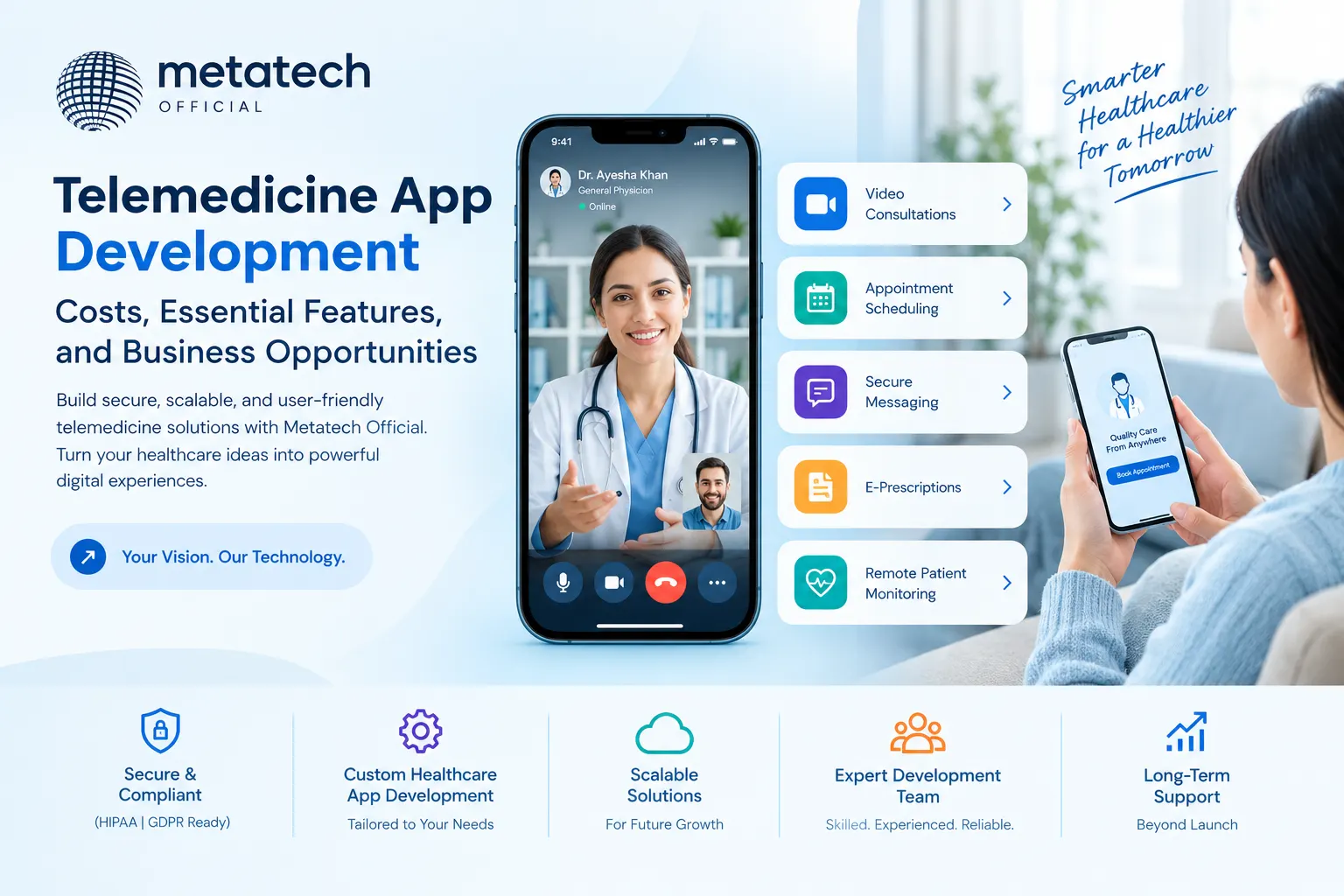
Virtual healthcare has expanded beyond basic online consultations. Modern platforms can support appointment scheduling, secure communication, electronic prescriptions, remote patient monitoring, and integration with other healthcare systems.
These capabilities create opportunities for several types of organisations, including private clinics, hospitals, healthcare startups, specialist practices, and businesses offering digital wellness services.
For patients, telemedicine can make accessing healthcare more convenient, particularly when travel, distance, or scheduling creates difficulties. For providers, digital tools can simplify appointment management, improve communication, and help organise administrative tasks.
Businesses considering healthcare mobile app development should begin by identifying a specific problem they want to solve. A clinic might need a simple appointment and consultation application, while a larger healthcare network may require multiple user portals, advanced integrations, and centralised administration.
A clear business objective provides the foundation for selecting features, estimating costs, and planning future expansion.
2. How Much Investment Does a Telemedicine App Require?
There is no universal price for building a telemedicine application. Development costs depend on the application's complexity, supported platforms, security requirements, team composition, integrations, and design specifications.
The following figures from the source article provide general planning estimates. Actual quotations may vary considerably depending on the project scope and development partner.
Application type | Estimated development cost | Estimated timeline |
Basic application | 40,000–70,000 | 2–3 months |
Medium complexity | 70,000–100,000 | 3–6 months |
Advanced application | 100,000–300,000 | 9+ months |
These figures are indicative rather than guaranteed prices. The timeline for a basic product may increase when security reviews, third-party integrations, regulatory requirements, or extensive testing are involved.
A basic solution might include patient registration, appointment booking, video consultations, and an administrative dashboard. A more advanced product could incorporate multiple healthcare professionals, electronic health record integrations, remote monitoring, analytics, and additional automation.
One useful starting point for estimating the budget is:
Estimated development cost = Total development hours × Blended hourly development rate
This calculation should also account for project management, quality assurance, design, infrastructure, compliance work, and other expenses that may not be included in the initial coding estimate.
3. The Decisions That Shape Your Development Budget
Before requesting a quotation from a telemedicine app development company, understand which project decisions are likely to affect your investment.
Feature requirements and application complexity
Features have a direct impact on development time. A platform with basic booking and consultation tools generally requires less work than one supporting multiple specialties, medical records, payment workflows, and remote monitoring.
Businesses should distinguish between features required for launch and those that can be introduced later. This helps prevent unnecessary complexity during the initial development phase.
Mobile platforms and device compatibility
Building separate native applications for iOS and Android can increase development and maintenance requirements. Cross-platform frameworks, such as Flutter or React Native, may allow teams to share much of their code across platforms.
The appropriate approach depends on performance requirements, device-specific functionality, accessibility needs, and the experience expected by users.
User experience and interface design
Healthcare applications must make essential tasks easy to understand. Patients should be able to find appointments, connect with providers, and access relevant information without navigating confusing menus.
Doctors and administrators also need interfaces suited to their responsibilities. Investing in research, prototyping, usability testing, and accessible design can reduce friction and help prevent costly redesigns later.
Development team and location
The overall budget depends partly on the expertise and structure of the development team. A project may involve UI/UX designers, mobile developers, backend engineers, quality assurance specialists, security professionals, and project managers.
In-house teams, freelancers, local agencies, and outsourced development partners have different pricing structures. Rather than choosing solely by hourly rate, compare relevant experience, communication, project management, technical expertise, and ongoing support.
Technology stack and third-party integrations
The technology stack influences scalability, maintenance, security, and compatibility with external systems. Video communication services, payment gateways, electronic health record systems, cloud infrastructure, and notification services may also involve integration or recurring usage fees.
Selecting technologies based on actual requirements helps avoid paying for unnecessary capabilities while leaving room for future growth.
4. Essential Capabilities for a Reliable Telemedicine Platform
A successful healthcare application should support the complete user journey, from registration to consultation and follow-up. The feature set will depend on the business model and the needs of patients and healthcare professionals.
Patient registration and profiles: Allow users to create accounts, manage relevant information, and access their appointments securely.
Appointment scheduling: Enable patients to view provider availability, book consultations, reschedule visits, and receive reminders.
Video consultations: Provide reliable communication between patients and healthcare professionals through an appropriate video service.
Secure messaging: Support communication for appropriate healthcare workflows, with suitable access controls and privacy protections.
Payment integration: Where applicable, allow patients to pay consultation fees and receive transaction confirmations.
Doctor dashboard: Give healthcare professionals tools to manage schedules, view authorised patient information, and organise consultations.
Administrative controls: Help authorised staff manage users, provider profiles, appointment activity, and operational settings.
Notifications: Send relevant reminders, appointment updates, and service notifications without exposing sensitive medical information unnecessarily.
Advanced applications may also require electronic prescriptions, health record integrations, remote patient monitoring, analytics, and insurance-related workflows. These features should be selected according to clinical requirements, applicable regulations, and the platform's intended use.
5. Privacy, Security, and Compliance Must Be Built In
Healthcare applications handle information that can be highly sensitive. Security should therefore be treated as a core architectural requirement rather than a feature added shortly before launch.
Depending on the markets served and the information processed, businesses may need to consider requirements such as HIPAA in the United States and GDPR in the European Union. Other national and regional healthcare privacy rules may also apply.
A suitable security strategy may include encryption, secure authentication, role-based access controls, audit logs, protected data storage, backup procedures, and ongoing vulnerability assessments.
Businesses should also review the privacy practices and contractual responsibilities of third-party providers. Using a cloud service or video API does not automatically make the complete application compliant with applicable healthcare regulations.
Compliance planning may involve legal consultation, security assessments, documentation, appropriate vendor agreements, and technical safeguards. These activities can affect both the initial budget and continuing operating expenses.
Working with an experienced telemedicine app development company can help organisations identify technical risks early and incorporate appropriate safeguards into the development process. However, compliance ultimately depends on the complete system, its operation, and the organization's responsibilities.
6. Budget Beyond Launch Day
The initial development quotation does not represent the full cost of running a telemedicine platform. Businesses should prepare a separate operational budget for ongoing expenses.
Hosting and infrastructure
Cloud hosting, storage, processing, video traffic, backups, and data transfer may generate recurring charges. Costs often change as the number of users and consultations increases.
Maintenance and technical support
Applications require bug fixes, operating system compatibility updates, performance improvements, and security patches. Businesses may also need support for new features and changing operational requirements.
Compliance and security reviews
Security assessments, legal guidance, vendor reviews, and regulatory updates can add continuing expenses. The exact requirements depend on the jurisdiction and nature of the healthcare service.
Marketing and customer acquisition
A technically sound application still needs a strategy for attracting patients and healthcare professionals. Search engine optimisation, educational content, targeted advertising, referral programs, and partnerships can support customer acquisition.
Third-party service charges
Video APIs, messaging services, payment processors, identity verification tools, and external healthcare integrations may have setup fees, subscription charges, or usage-based pricing.
Planning for these expenses from the beginning makes it easier to estimate the platform's total cost of ownership rather than focusing exclusively on development.
7. Reduce Initial Costs Without Sacrificing Quality
Cost optimisation is most effective when businesses prioritise carefully instead of removing essential safeguards.
Start with a minimum viable product
A minimum viable product (MVP) includes the core capabilities needed to test the business concept. For example, an initial release might support registration, appointment scheduling, video consultations, secure access controls, and basic administration.
After gathering feedback from actual users, the business can decide which additional features deserve investment.
Prioritise features by business value
Separate essential launch requirements from optional enhancements. Advanced analytics, complex automation, and additional integrations may be introduced later if they are not necessary for the initial service.
However, privacy, security, and applicable compliance requirements should not be treated as optional extras.
Consider cross-platform development
A shared codebase may reduce duplicated development effort when building for multiple mobile platforms. Evaluate the approach against performance, functionality, and long-term maintenance requirements before making a decision.
Plan integrations early
Identify required external services during the discovery stage. Understanding their technical limitations, licensing costs, and integration requirements can help prevent unexpected expenses.
Choose a capable development partner
A low initial quotation may not reflect the complete project cost. Evaluate the provider's technical process, healthcare-related experience, communication practices, testing approach, and post-launch support.
The goal is to build the right product with a realistic budget, not simply to choose the lowest price.
8. Revenue Models for Telemedicine Businesses
A sustainable revenue strategy depends on the audience, healthcare services offered, operating costs, and applicable regulations.
Pay-per-consultation: Patients pay for individual appointments or consultations, where permitted by the business model.
Subscription plans: Users pay recurring fees for a defined set of services or membership benefits. Any medical services included must comply with applicable professional and regulatory requirements.
Business-to-business licensing: A company may provide its platform to clinics, hospitals, or corporate clients through licensing or software-as-a-service arrangements.
Provider or platform fees: Depending on the business structure and applicable laws, the platform may charge healthcare providers for software access or administrative services.
Healthcare partnerships: Partnerships with employers, insurers, clinics, or other organisations may create additional distribution and revenue opportunities.
Advertising is another possible model in some digital health contexts, but it requires particular care. Commercial content must not compromise patient privacy, mislead users, or interfere with appropriate medical care.
Before selecting a monetisation strategy, estimate recurring costs, expected user adoption, customer retention, and the revenue required to sustain the platform.
9. Develop Your Healthcare Application With Metatech Official
Building a telemedicine application requires a clear understanding of healthcare workflows, user expectations, technical architecture, and business goals. A well-planned project can help healthcare organisations deliver convenient digital services while preparing their platforms for future development.
Metatech Official provides custom website and mobile application development services focused on creating scalable, secure, and practical digital solutions. Our development approach can include planning, UI/UX design, application development, API integrations, testing, and ongoing technical improvements according to project requirements.
Businesses exploring custom healthcare app development should begin by defining their intended users, required features, supported platforms, integration needs, and security obligations. These decisions provide a stronger foundation for estimating costs and selecting an appropriate technical approach.
Whether you are launching a healthcare startup, modernising an existing clinic's digital services, or planning a specialised patient application, Metatech Official can help turn your requirements into a structured development plan.
Ready to explore your telemedicine app idea? Contact Metatech Official to discuss your requirements, identify essential features, and plan a solution aligned with your budget and long-term objectives.
Frequently Asked Questions
1. How much does telemedicine app development cost?
The cost depends on features, platform selection, integrations, security requirements, and development team rates. General estimates range from $40,000 to $70,000 for a basic application and $100,000 to $300,000 for a more advanced solution. A detailed project assessment is necessary to establish a realistic quotation.
2. How long does it take to develop a telemedicine application?
A basic application may take a few months, while a medium-complexity platform can require several months. Advanced applications may take nine months or longer. Testing, integrations, regulatory requirements, and changes in project scope can affect the final timeline.
3. What features should a telemedicine app include?
Common features include patient registration, appointment scheduling, video consultations, secure messaging, notifications, payment processing, doctor dashboards, and administrative controls. Electronic health records, remote monitoring, and advanced analytics may be added when required.
4. How do I select the right telemedicine app development company?
Evaluate the company's technical capabilities, relevant project experience, security practices, development methodology, communication, pricing transparency, and maintenance services. Ensure the team understands the privacy and compliance considerations relevant to your intended market.
5. Why should businesses invest in custom healthcare app development?
A custom solution can be designed around specific clinical workflows, patient needs, business objectives, and integration requirements. It may also provide greater control over functionality and future improvements. The benefits depend on effective planning, appropriate implementation, regulatory compliance, and ongoing investment in the platform.